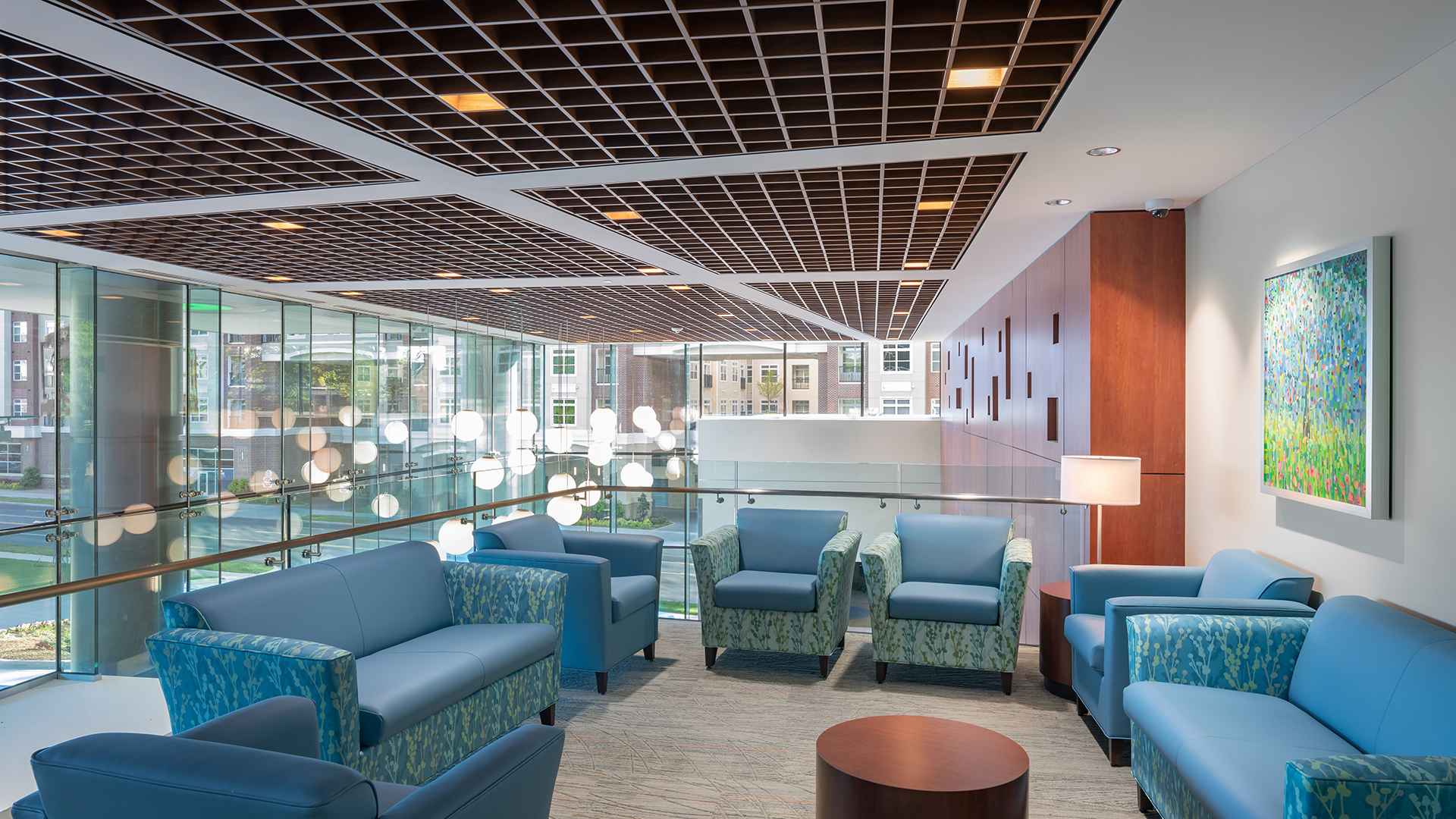
“Variety of form and brilliancy of colour in the objects presented to patients are actual means of recovery.”
– Florence Nightingale
Art holds a power that extends far beyond aesthetics. It connects us, comforts us, offers hope, and helps us rediscover ourselves at life’s most vulnerable moments.
For nearly a decade, I’ve worked alongside architects, designers, and healthcare systems to create spaces where some of life’s most difficult moments unfold. Our goal is always the same: environments that are not only physically safe and functional, but emotionally supportive and human-centered. My own perspective on these spaces is also shaped by a background in the arts. Before joining Little, I earned a BA in History of Art and an MA in Art Business and worked in the art industry in New York City. As healthcare has embraced more human-centered approaches to design, I’ve become increasingly interested in how these two parts of my background intersect, particularly in the role art can play within the healthcare environment.
A growing body of research already demonstrates art’s impact on health and well-being. I wanted to explore that impact through a more personal lens, so I spoke with four people whose lives intersect with healthcare in very different ways: a patient, a family member, a caregiver, and a designer.
What emerged from those conversations is a consistent answer to a question every healthcare organization should be asking: what does art give patients, families, and staff that clinical care alone cannot? Four answers surfaced: identity, connection, hope, and a way to process what’s difficult to put into words. Together, they make a case for treating art not as decoration, but as part of the clinical environment itself.
THE VOICES BEHIND THE RESEARCH
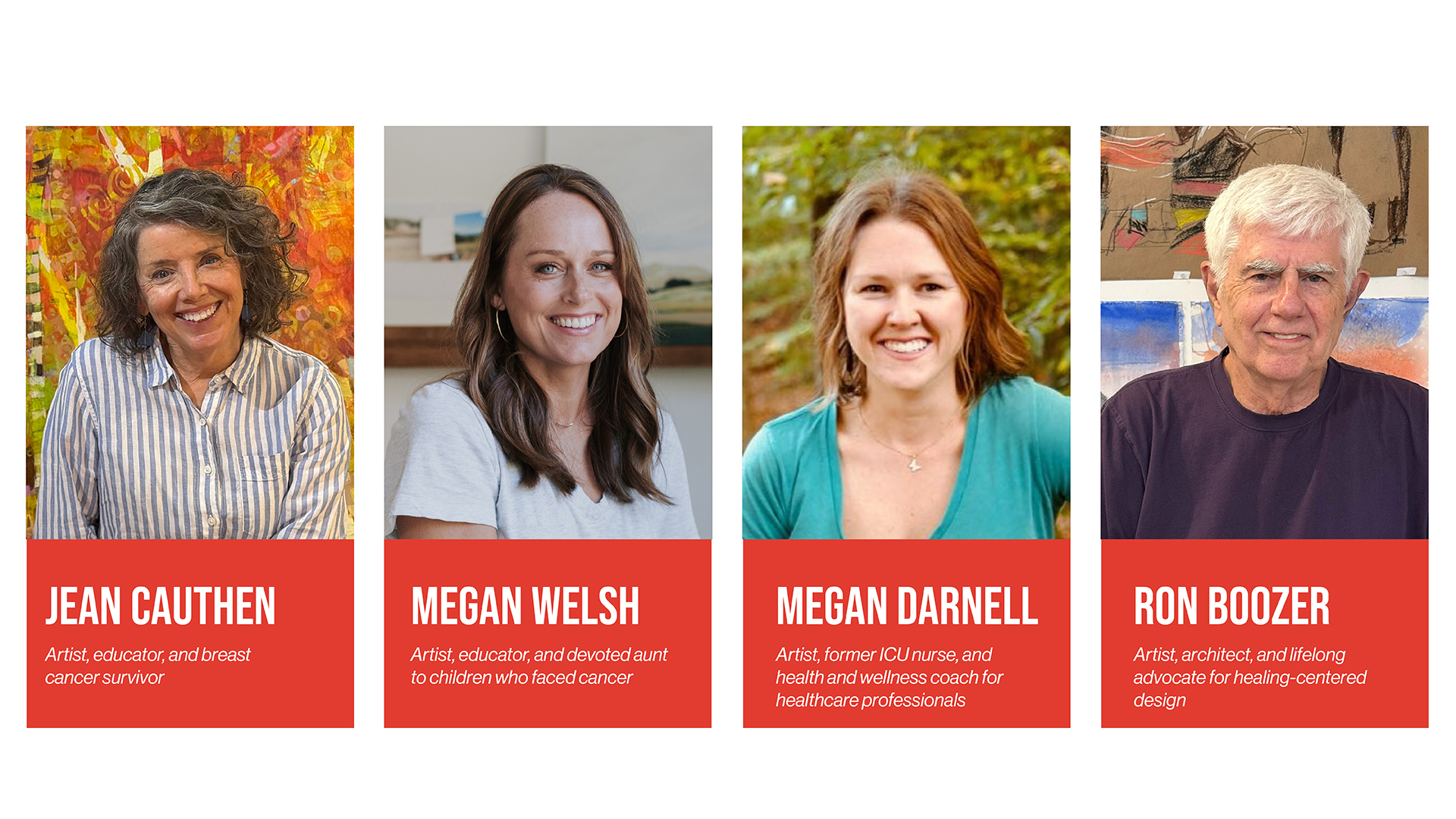
Jean Cauthen is an artist, educator, and breast cancer survivor. Her resilience shows up throughout her work, from plein air landscapes (paintings created outdoors in direct contact with nature), commissioned pieces, and richly layered floral and forest paintings reminiscent of Gustav Klimt.
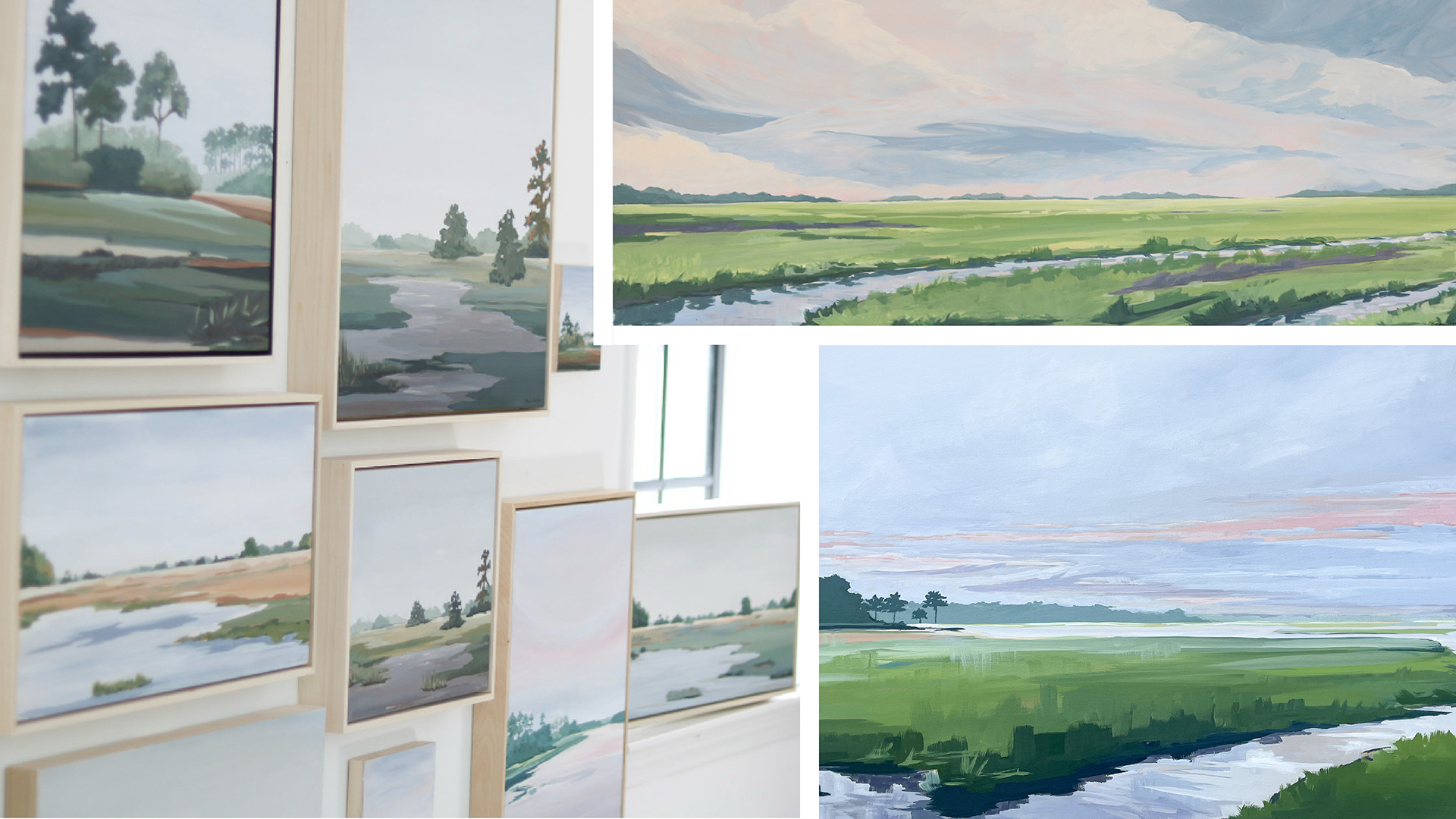
Megan Welsh is an artist and longtime educator known for tranquil landscape paintings inspired by the marshes, mountains, and coastlines she explores with her family. Her connection to healthcare is personal rather than professional: both of her sisters had children diagnosed with cancer, giving her a firsthand understanding of what families endure during extended hospital stays.
Megan Darnell is a former ICU nurse who now works as an artist and health-and-wellness coach for healthcare professionals. She uses creativity to help herself and other clinicians process difficult experiences and find moments of restoration.
Ron Boozer is an architect, healthcare designer, and artist who has spent his career creating spaces that support healing through thoughtful design. His relationship to healthcare began young, through his mother, a nurse in a long-term pediatric unit who used to invite him to draw alongside her patients and later encouraged him to paint a mural in a small, uninspired waiting room for expectant fathers.
Together, their experiences span the full healthcare journey: receiving a diagnosis, supporting a loved one, providing care, and designing the spaces where all of it happens. Four different vantage points, and the same conclusion from each of them: art offers something medicine alone cannot.
IDENTITY: ART REMINDS US WHO WE ARE
Receiving a diagnosis can turn a person’s life upside down. As appointments, treatments, and test results take over, it’s easy for a complex person to be reduced to a condition that needs managing. But behind every diagnosis is someone with relationships, passions, and an identity that extends far beyond illness.
Sitting with Jean in her studio at Charlotte’s Dilworth Artisan Station, I was struck by how deeply the space reflected her personality. Radiating the same vibrant energy and color found throughout her artwork, the studio felt like an extension of Jean herself. Creativity isn’t just what Jean does; it’s how she moves through the world.
She was diagnosed with breast cancer during the late stages of COVID, when masks, distancing, and safety protocols deepened the anonymity she already felt as a patient. Surrounded by others undergoing the same treatment, she began to feel like her individuality had disappeared. “Do they really see me?” she recalled wondering. “Or am I just another butt in a chair?”
That changed during an appointment when she casually commented on a piece of artwork in her doctor’s office. The remark sparked a conversation about their shared love of art and about Jean’s own work, which happened to be displayed at Levine Cancer Institute (LCI). In that moment, she was no longer seen only as a patient. She was recognized as an artist. From then on, their conversations extended beyond treatment to include her work, her creativity, and the part of herself that cancer had threatened to overshadow.
Megan Darnell saw the same dynamic from the caregiving side. She once cared for a watercolor artist going through a difficult hospitalization. Working with the patient’s family to bring back a sense of normalcy, Megan and her team made space for the patient to paint. It was a simple gesture, but a meaningful one: by creating the opportunity, they let her be something other than her illness. She was still an artist.
Creative expression can preserve the parts of a person that illness threatens to overshadow. It reminds everyone in the room—clinicians included—that behind every diagnosis is a whole person.
CONNECTION: ART REMINDS US WE ARE NOT ALONE
Illness is isolating in a way that’s easy to underestimate. When you no longer feel like the person you were before a diagnosis, the relationships that once felt natural can become harder to hold onto. Losing your sense of identity and feeling alone tends to happen together.
Ron has spent his career learning that it’s impossible to predict how any one patient will respond to an environment. Healthcare facilities serve too many people, at too many different stages of their journey, for any single design choice to land the same way twice. That reality can push design toward safe, neutral, and ultimately impersonal solutions. What designers can do is listen, learn, and anticipate, translating what they hear into spaces that make people feel seen. As Ron put it, good design communicates something simple: We hear you. We see you. You are not alone.
His own childhood shaped that belief. He remembers a pediatrician who practiced out of “a small Victorian house with an inviting rocking-chair front porch, a living room to wait in, and an exam room that looked like a bedroom.” Because the setting felt familiar, those visits “were not dreaded or feared.” It’s the question he still asks as a designer: how do you make a clinical space feel hospitable instead of institutional? Ron believes art is one of the clearest answers, especially when it’s considered alongside architecture and interior design from the start, rather than added afterward. Regional, recognizable imagery can be especially powerful here, giving patients a sense of place and familiarity in a setting that otherwise feels generic.
Jean experienced that connective power directly. A fellow artist undergoing treatment at LCI recognized one of her paintings near the infusion suite and reached out. “This painting has meant more to me than anything else during my treatments,” he told her. Each time he returned for an infusion, he sent her a photo of it, sparking an ongoing conversation between two artists navigating a shared experience. Through her work, Jean offered companionship without ever being physically present.
This is the connective power of art that has always fascinated me. It can create common ground between people who may never otherwise meet, allowing us to recognize something of ourselves in someone else’s experience. Especially during difficult moments, that connection can be a quiet reminder that what we are carrying does not have to be carried entirely alone.
Megan Welsh has seen that same power outside clinical settings. A family once commissioned one of her landscapes for a relative going through a difficult chapter, choosing a place with deep personal meaning so the piece would become a reminder of shared memory rather than the difficulty itself. As Ron summarized it: “Including art in healthcare facilities communicates respect for patients, families, and staff.” Art doesn’t need to mean the same thing to everyone in a room to make people in that room feel less alone.
HOPE: ART HELPS US SEE BEYOND THE PRESENT MOMENT
Hope in healthcare isn’t about ignoring how hard things are or promising everything will be fine. At its most meaningful, it acknowledges uncertainty while still pointing toward movement and possibility beyond the current moment.
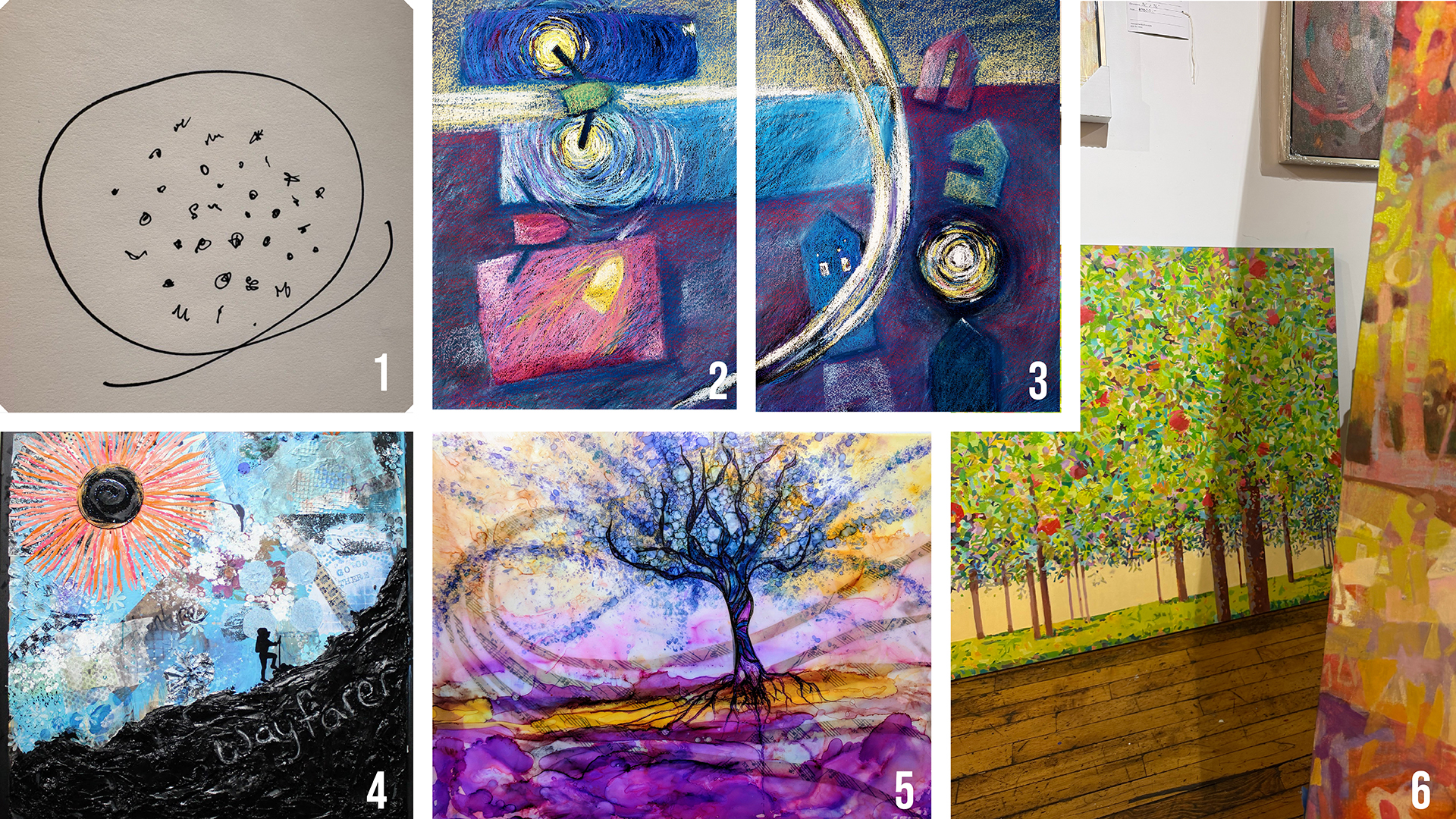
Megan Darnell’s years in the ICU reshaped how she thinks about healing not just as physical recovery, but as something that has to include the moral distress, compassion fatigue, and exhaustion clinicians carry. That understanding shows up in her piece Wayfarer: a lone hiker climbing a steep hillside toward the light of a new day, rendered in rich texture and color. As she put it, “Sometimes all you can do is take one step at a time.”
Ron’s contribution to the art collection at the LCI expansion takes a related idea further. Drawing on his own family’s experience with cancer, he set out to turn something deeply personal into something universal. The resulting large pastel drawing shows boats navigating stormy seas toward a distant lighthouse. A journey into darkness, illuminated by a healing arc of light. Positioned along the central pedestrian spine where LCI’s two buildings meet, it offers a quiet moment of reflection to everyone who passes through.
Jean’s own journey shifted how she approaches art made for others. Her guiding questions changed from “What do I want to paint?” to “What would make someone feel better? What colors calm me? What would I want to see during a difficult time?” Those questions now shape everything she makes for healing environments.
For Megan Welsh, hope is the chance to mentally step outside the room you’re in. “I want people to almost step into the painting, to be transported somewhere else, even if it’s just for a moment,” she said, comparing it to the scene in Mary Poppins where Bert draws the children into his chalk illustrations. “It’s a broken world,” she reflected, “but there’s still so much beauty.” That’s what she hopes her landscapes offer patients: not an escape from reality, but a reminder that beauty and possibility still exist alongside it.
As Jean put it: “I don’t want paintings that simply calm people. I want paintings that calm and engage them at the same time.”
EMOTIONAL PROCESSING: ART GIVES FORM TO WHAT WE CARRY
Art creates space for emotions that are hard to name, articulate, or contain. It doesn’t necessarily resolve those emotions, but it gives them somewhere to go. I have always thought of art as a form of communication, particularly when words aren’t enough. Art gives us another language—one that can give form to what we are carrying, help us make sense of disorder, or simply allow us to sit with something we aren’t yet ready or able to put into words.
During her time as an artist-in-residence, Jean saw how consuming a diagnosis can be, leaving little room for patients to think about anything else. Her instructor described the artist’s role as giving patients a “vacation” from their fears, even just fifteen minutes where the diagnosis isn’t the only thing occupying their mind. In one activity, Jean invited patients to make scattered marks on a page—Xs, dots, simple lines—and watched them instinctively bring order to the chaos with color and pattern. She wondered whether that process mirrored something deeper: lives disrupted by illness, quietly finding a moment of harmony within the disorder.
Megan Welsh saw a version of the same thing happen through environment rather than activity. Both of her sisters spent extended stretches in a children’s hospital with sick kids, and when she asked them what they remembered most, neither mentioned a treatment nor a procedure. Both described the same gathering space: a large sculptural tree, natural light filtering through overhead, the soft sound of birds. A place where overwhelmed parents could step away, breathe, and let their nervous systems settle. A small architectural intervention that became one of the most enduring memories of an incredibly hard chapter.
That emotional weight isn’t carried by patients and families alone. Clinicians deliver difficult news while offering comfort and stay clinically focused while remaining empathetic, often while burning out. Megan Darnell lived this as an ICU nurse, whose nervous system stayed on high alert even during quiet moments.
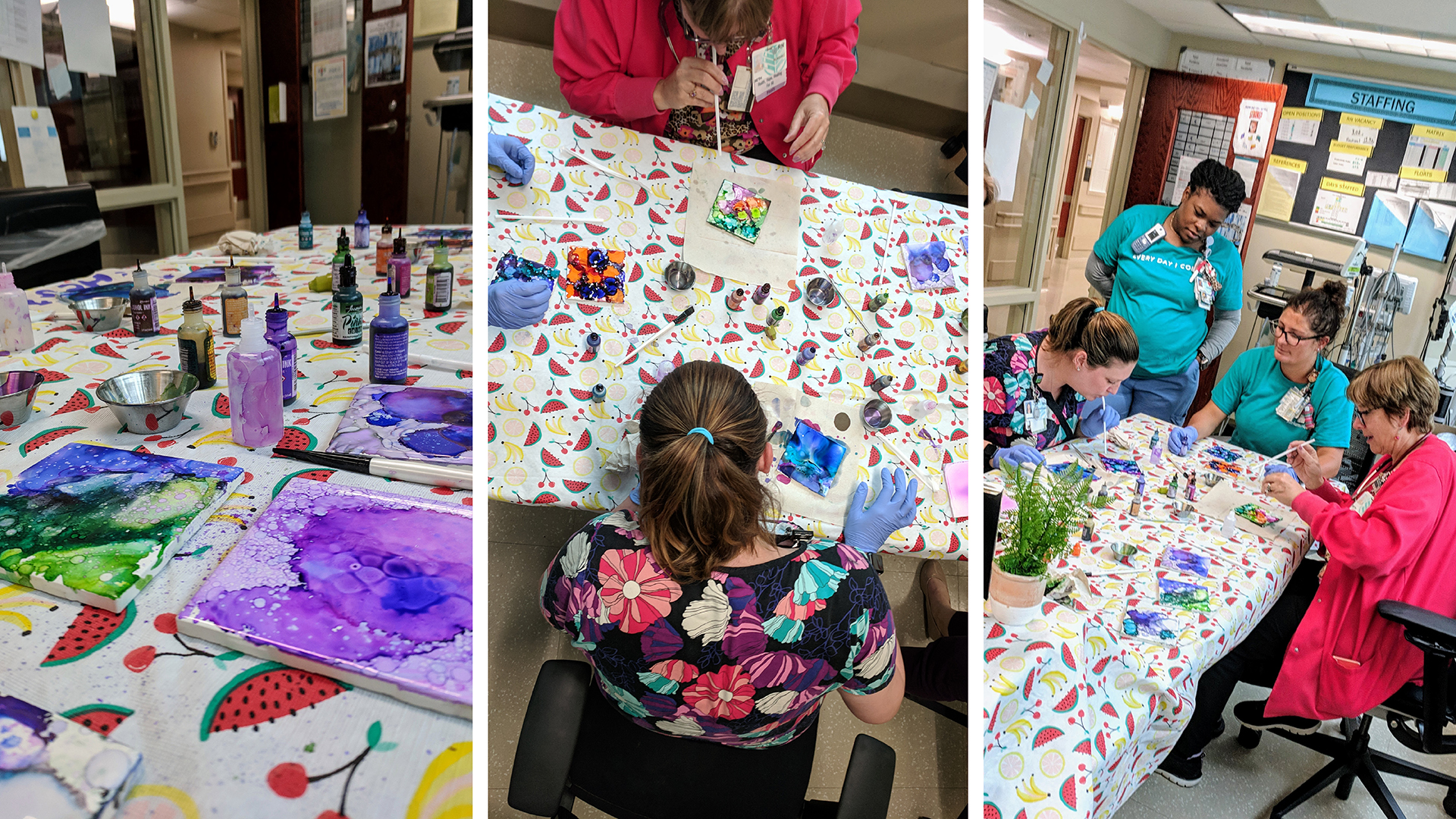
Art became part of her own recovery, and now she brings it back to her former colleagues. During one Nurses’ Week, she gave staff small ceramic tiles and alcohol ink and invited them to pause mid-shift, with permission to wipe the tile clean if they didn’t like the result. One nurse got so absorbed in the process she left without keeping her tile at all: “I had so much fun making it that I didn’t need to keep it.” As Megan put it, “Art is like a bubble bath for your brain.” The value isn’t the finished piece. It’s the few minutes of actually being present.
WHAT THIS MEANS FOR HEALTHCARE DESIGN
These four stories point to the same conclusion from four different directions: thoughtfully integrated art isn’t a finishing touch. It’s part of how a healthcare environment functions.
A few takeaways worth carrying into practice:
Bring art into the process early. Ron’s career-long argument is that art works best when it’s considered alongside architecture and interior design from a project’s earliest stages, not layered on at the end as decoration. Art introduced late tends to feel exactly like what it is: an afterthought.
Design for restoration, not just function. Megan Welsh shared about her own hospital stay, where she spent days facing bare walls and a view of the roof, is a reminder that even small design decisions shape how a space feels to occupy for an extended period. A single piece of art, or a view of something alive, can be the difference between a room that feels clinical and one that feels human.
Don’t overlook staff. Megan Darnell’s work with clinicians highlights something healthcare design can undervalue: caregivers need restorative space, too, and modest interventions like biophilic art, warmer materials, or artwork in unexpected places like ceiling tiles above a procedure bed, can offer real relief when larger architectural changes aren’t feasible.
Build in permission, not just space. As Megan Darnell observed, a restorative space only works if people feel allowed to use it. Leadership has to actively create a culture where pausing, reflecting, and stepping away isn’t treated as a lapse in dedication.
Let art mean different things to different people. No single piece will resonate with everyone who encounters it, and that’s not a design failure. It’s the point. The goal isn’t universal meaning; it’s giving people the room to find their own.
None of this requires monumental intervention. Sometimes it’s a painting that reminds someone of home, a view of something growing, a quiet corner that invites a person to stop moving for a minute. Art can’t eliminate illness or uncertainty. But as these four artists made clear, it can help people remember who they are, feel less alone, imagine something beyond the present moment, and find a place to put what they’re carrying. That’s something medicine alone can’t offer and it’s something design can.