This article originally appeared in Talking Stick, a bimonthly publication from ACUHO-I.
“The greenest building is the one that is already built.” Campus housing professionals would be wise to keep that quote, attributed to Carl Elefante, a former president of the American Institute of Architects, fresh in their minds when considering their sustainability initiatives. It is also applicable to the decision-making process as they examine how to address the aging infrastructure across their campuses.
Updating campus facilities and meeting sustainability goals are two challenges at the top of many a campus housing department’s to-do list. Fortunately, while choosing to renovate a hall rather than build a new one is often driven by fiscal concerns, campuses can also point to a number of environmental, ecological, and human-centered reasons to renovate rather than replace. Some of these benefits are rather obvious. A renovation means reducing the need for new concrete and steel, which are the most carbon-intensive materials used in construction. Fewer materials end up in landfills. Work is done more quickly. Emissions from equipment and transportation are reduced. But even beyond those substantial factors, renovating a hall can deliver distinct lessons about land preservation, building performance, indoor health, embodied carbon, and innovative design strategies.
THOUGHTFUL CHOICES
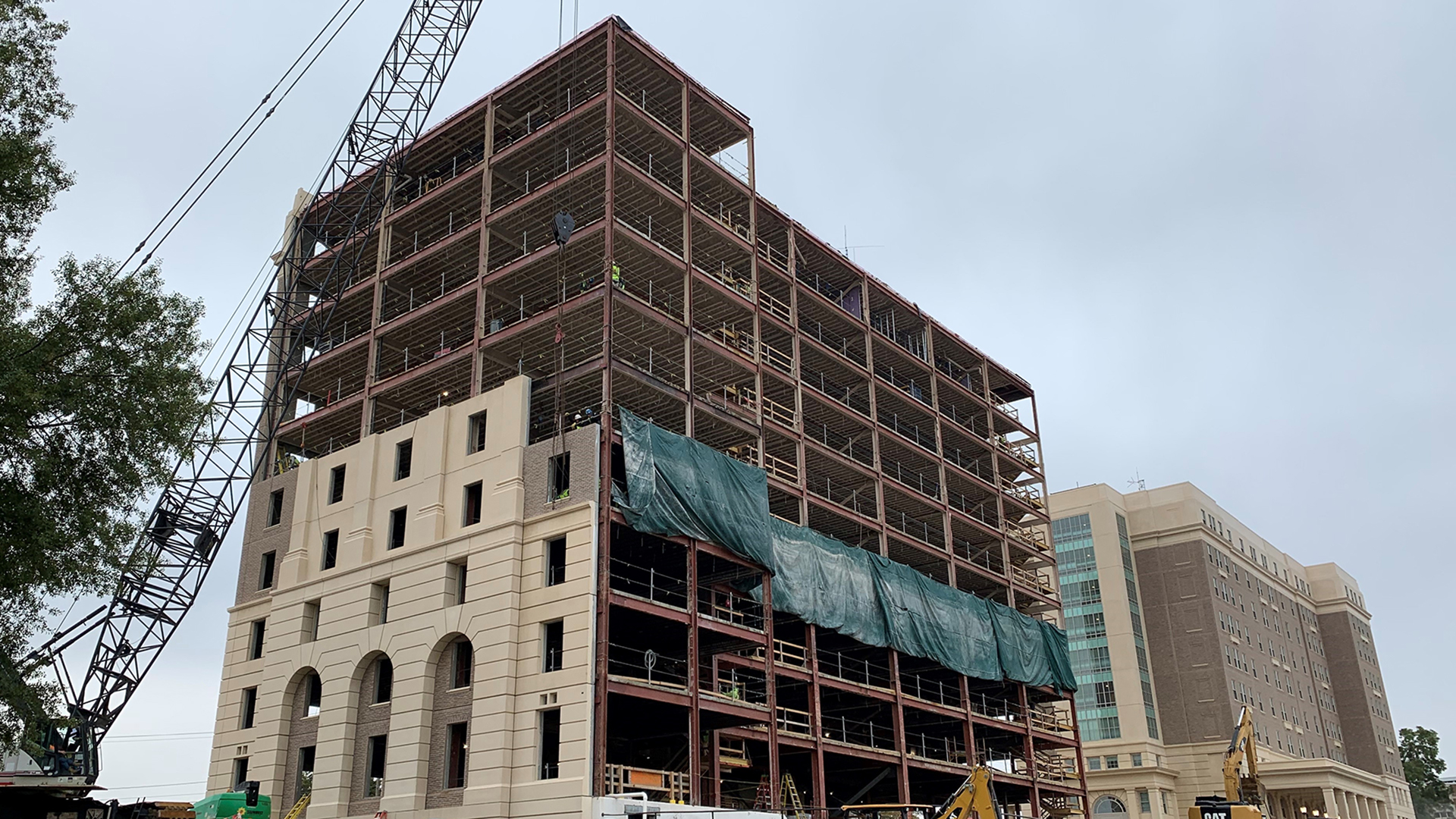
In 2023, Clemson University began an expansive, multi-year effort to update the three residence halls that sat on the campus’ Bryan Mall. The 10-story halls, combined, were home to approximately 1,200 students. As the project proceeds, there will be substantial investments in mechanical upgrades that will increase efficiencies and, in turn, reduce energy use and utility costs. Perhaps the largest sustainability benefit, though, will come from what the campus chose not to do. By choosing to update the existing buildings rather than replace them, the process will preserve most of the existing steel and concrete, reducing embodied carbon by approximately 60%, which is equivalent to removing 1,300 passenger cars from the road. Preserving the structure reduced construction waste to landfills by roughly half. And as an often-overlooked factor, if Clemson had attempted to construct 300,000 square feet of new housing, it would have required approximately 3 million gallons of water, while the renovation process required only one-sixth of that amount.
In 2023, Clemson University began an expansive, multi-year effort to update the three residence halls that sat on the campus’ Bryan Mall. The 10-story halls, combined, were home to approximately 1,200 students. As the project proceeds, there will be substantial investments in mechanical upgrades that will increase efficiencies and, in turn, reduce energy use and utility costs. Perhaps the largest sustainability benefit, though, will come from what the campus chose not to do.
By choosing to update the existing buildings rather than replace them, the process will preserve most of the existing steel and concrete, reducing embodied carbon by approximately 60%, which is equivalent to removing 1,300 passenger cars from the road. Preserving the structure reduced construction waste to landfills by roughly half. And as an often-overlooked factor, if Clemson had attempted to construct 300,000 square feet of new housing, it would have required approximately 3 million gallons of water, while the renovation process required only one-sixth of that amount.
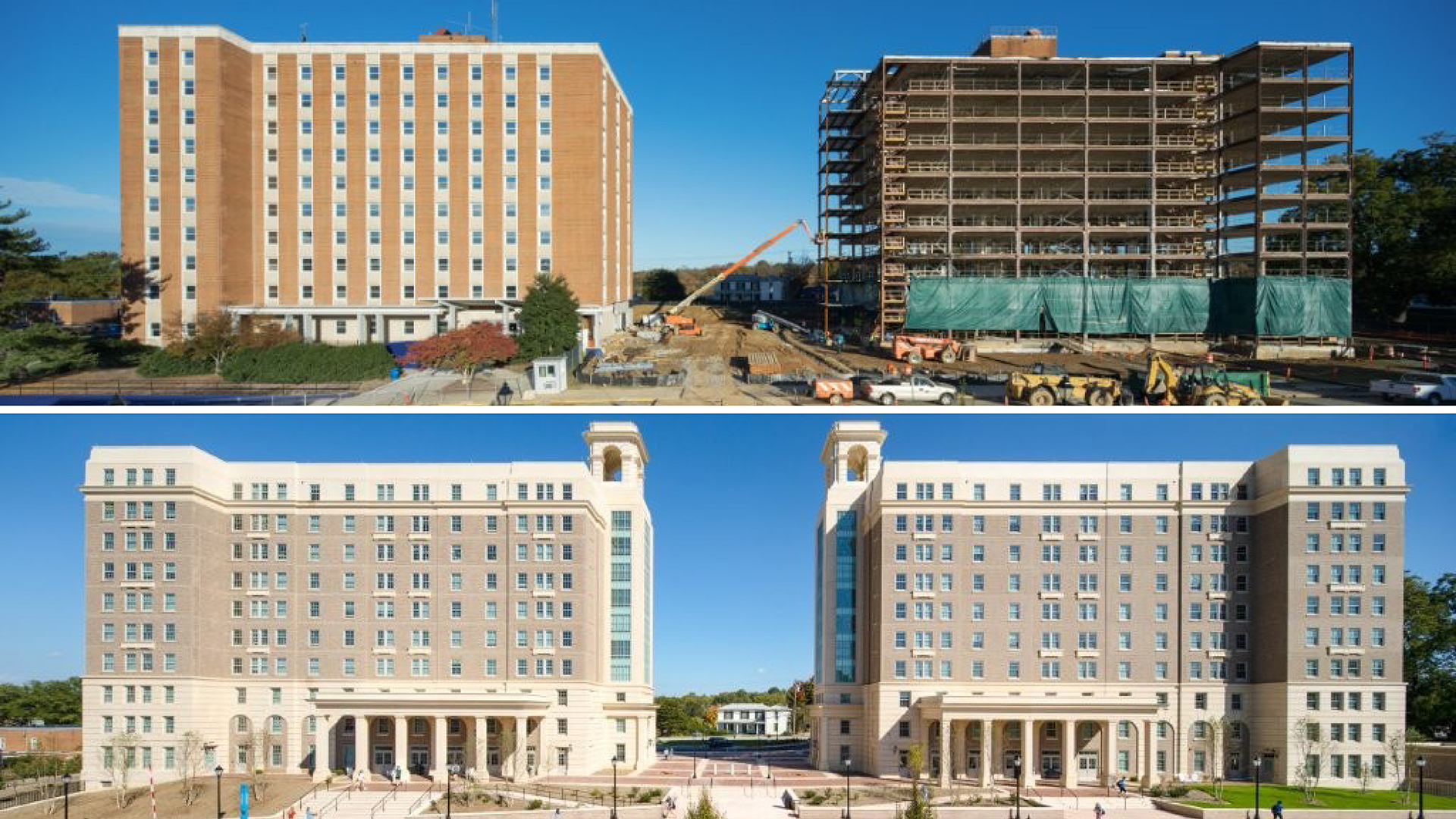
A similar challenge faced Longwood University, a public university in Virginia that has existed for nearly two centuries and is focused on honoring that history while also keeping up with evolving student needs. Longwood’s Moss and Johns residence halls, constructed in 1970, are youngsters compared to other campus buildings, but that didn’t stop them from recently showing their age and generating thoughtful consideration around their futures. Demolishing them would have displaced approximately 800 students — mostly first year — on an already tight campus and generated tremendous construction waste. Replacing the towers with similar high‑rise construction would be expensive. And while current trends might dictate replacing those high-rises with multiple buildings of four or five stories, that would have required almost 20 acres of development space, space the campus simply doesn’t have, and the resulting ecological damage would take decades to recover.
Unlike many renovation efforts, which focus primarily on building interiors and systems, the Longwood project also replaced the building’s entire façade. This was done not only to better unify the buildings aesthetically with the rest of the campus architecture but also to deliver a higher-performing envelope.
Many large-scale buildings in the 1960s were constructed with little insulation and, notoriously, were not air-tight. Additionally, these buildings usually relied on natural ventilation, as well as an envelope that breathed, to help inhabitants remain cool. In today’s world of central air conditioning systems, though, the new insulated precast panels provide far better thermal performance, minimize waste, and reduce air leakage, an essential step in lowering energy use. A tighter envelope can reduce energy consumption by as much as 50% when paired with efficient mechanical systems. It also reduces the upfront system tonnage requirements and overall cost.
Air leakage tests during the renovation are often conducted to measure performance. An air change level less than 0.15 cubic feet per minute per square foot (or CFM/SF) at 50 pascals pressure differential (or ACH50) is recommended to ensure long-term performance. Another test to consider is post-thermal imaging to demonstrate envelope performance. This test will visually show a building’s performance. When the test was done during the winter months on a building at The Catholic University of America that used the same precast insulated system installed at Longwood, the exterior wall temperature was 29 degrees Fahrenheit, while the same wall measured a comfortable 73 degrees Fahrenheit on the interior side. Insulation and mechanical systems certainly do matter, but the building envelope and its ability to be as airtight as possible make an even bigger impact.
Depending on the building type, calculations to determine in-wall dewpoint and wall composition may be needed to guide the team on proper mitigation of moisture. This calculation provides a general idea of where moisture can occur in the wall based on insulation and moisture barriers (or lack thereof). Generally, the older a building is, the deeper into the wall inspectors will go before they suggest steps to correct existing conditions before renovation begins.
Sometimes, the best solution is one that combines renovation efforts with selective replacements. Stanback Hall at Catawba College in Salisbury, North Carolina, was originally built in 1927, while additional building wings were added in 1957 and 1961. In this case, the historic central portion of the building fit the campus’s architectural language and needed to be preserved, though it would be improved to meet modern standards. The wings, though—which were utilitarian, poorly insulated, moisture-prone, inaccessible, extremely difficult to heat and cool, and lacked any system providing fresh air—had to go. This assessment led to an approach that balanced heritage conservation with performance and environmental responsibility.
The Stanback renovations also provided an opportunity to connect the building to the campus-wide District Energy and Modernization project. Scheduled for completion this month, the initiative includes plans for a “a closed-loop geoexchange heating and cooling system that will connect 90% of the campus infrastructure and bring us closer to a zero-carbon campus.” The updated Stanback Hall will feature new electric pumps and fans, which will reduce energy costs and improve indoor air quality. Meanwhile, the replacement wings also include flat roofs designed to support photovoltaic panels.
These strategies reinforce how campus-scale energy planning must be considered in renovation decisions, as well as how sustainability can be defined and understood in multiple ways. For example, in construction, operational carbon is often measured by energy use intensity (EUI). While the new systems will slightly increase EUI relative to the original (Largely because the old building lacked any outside air ventilation, which is now required by code), it will create healthier, safer, and more comfortable environments for students.
PROMOTING WELL-BEING
Just as renovation projects provide opportunities to update systems and technologies to greater sustainability standards, it also can provide a chance to rethink previous norms. When the College of Wooster in Ohio announced it would convert an old school building, originally built in 1901, into a residence hall, some were unsure how that would work. Again, rather than tearing a historic structure down and starting from scratch, renovating the building into the Gault Schoolhouse residence hall, demonstrated an innovative approach to adaptive reuse. Repurposing the classroom modules—each approximately 1,000 square feet—and preserving large existing windows, the design minimized demolition, reduced cost, and maximized natural light.
What made this project work was the decision to reimagine sleeping areas as micro‑units: efficient, carefully detailed, and inward‑facing to minimize ambient light and create quiet sleeping environments. Locally sourced materials and Amish‑crafted built‑ins supported the region’s economy while reducing transportation‑related carbon emissions.
Constructing fewer square feet of building space is inherently more sustainable and micro‑living has proven highly successful at Wooster and has also been applied at other campuses, including the College of Charleston in South Carolina. There, the same approach allowed an existing building to increase its capacity from 85 to 108 beds. A typical 140-square-foot single room can be reduced to 90 square feet when designed with precision. Across a 300‑bed project, for example, that saved square footage could equate to a reduction of nearly 1,800 metric tons of carbon, the equivalent of planting 80,000 trees.
Finally, while energy efficiency is essential in renovation, human health and well‑being are equally important. Students spend countless hours in residence halls, making indoor air quality and comfort fundamental. This was the most challenging aspect of converting a hotel into student housing at a mid-level public university campus in the southeastern United States, an area where the climate is notoriously hot, humid, and susceptible to extreme storms. The building envelope and exterior insulation finishing system were failing. The façade leaked, contributing to significant moisture and humidity issues: conditions that affect comfort, structural durability, and indoor environmental quality. Like the Longwood project, this renovation required a new exterior envelope. Designers selected a rainscreen system because it is lightweight, dries efficiently, drains moisture, and performs especially well in warm, humid climates. Rainscreens may seem counter-intuitive to some folks because they let moisture and rain pass through the outer layer of the façade, but the inner layer is watertight, and this system ensures that water and moisture are not trapped in the wall, a common issue in more conventional construction. Once the renovations are complete, the properly designed rainscreen will dramatically improve indoor conditions, reduce the risk of mold, and provide a more resilient façade, all essential to creating healthy student housing.
On campuses around the world, there is no shortage of residence halls and other buildings in need of a literal and figurative facelift. And while there are many reasons to take on those projects, it should be stressed that renovation is one of the most impactful sustainability strategies available. When done with an appropriate level of focus on sustainability initiatives, this process can significantly reduce embodied carbon, preserve land and ecological systems, minimize construction waste, save substantial water, improve indoor health and well‑being, encourage innovation in design and programming, and extend the life and cultural value of campus landmarks.
Sustainability comes in many forms, but choosing reuse over replacement, whenever possible, should always be central to campus planning. By doing so, campuses can turn buildings that were a black eye into a green victory.