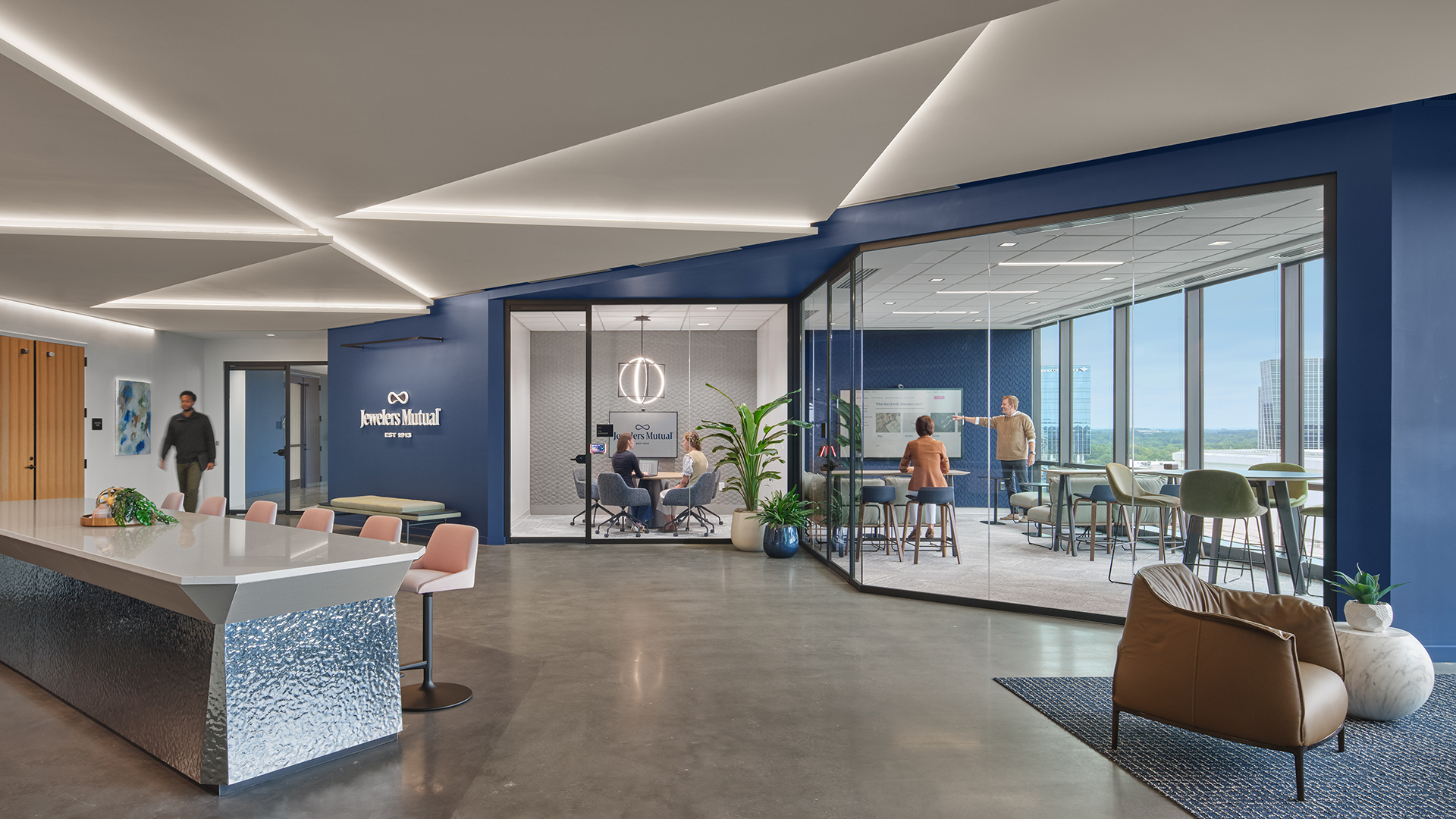
Think about the last time you spent a full day at the office. Your attention likely moved from laptop to phone to meeting notes, rarely lifting beyond eye level. Most workplaces are designed around what is directly in front of us, while everything above is often designed with a focus on utility. But that constant downward focus comes at a cost. It can narrow thinking, drain mental energy, and limit creativity over time. What if one of the simplest ways to counteract that is not on the desk, but overhead? Ceiling design has the potential to act as a subtle but powerful reset for the brain, influencing how people feel, think, and perform throughout the day.
This idea becomes clearer when you step back and look at how most of us interact with our environments throughout the day. A consistent behavioral pattern has emerged that reinforces a “downward gaze.”
THE PROBLEM: WORKPLACES DESIGNED FOR THE “DOWNWARD GAZE”
The modern gaze refers to the way our attention has become increasingly fixed on near-field, downward-facing tasks. Phones, laptops, tablets, and printed materials dominate our visual world. In doing so, they quietly shape not just what we see, but how we think.
This “downward tilt” is reinforced everywhere. We wake up and immediately look at a screen. We commute while looking at a screen. We work, communicate, and even relax through a small, hand-held rectangle that keeps our visual field constrained and close.
Over time, this sustained focus on near, detailed information can create a subtle but meaningful cognitive shift. The brain becomes trained for constant scanning, rapid switching, and detail processing. While this is essential for modern work, it can also lead to mental fatigue, reduced creative capacity, and a narrowing of perspective. In business terms, it affects the ability to think expansively, connect ideas, and sustain deep focus over time.
THE SCIENCE OF LOOKING UP
Environmental psychology and neuroscience both suggest that physical space influences cognitive state. One of the most well-documented examples is the Cathedral Effect.
Research indicates that higher ceilings, generally 10 feet or more, tend to prime the brain for abstract, relational, and creative thinking. People are more likely to think broadly, make conceptual connections, and engage in exploratory thought. In contrast, lower ceilings, closer to 8 feet, tend to support detail-oriented and analytical tasks, where focus and precision are required.
This response is tied to spatial perception. Our brains interpret vertical expansiveness as a cue for openness and possibility. Environments that feel physically larger can reduce stress responses and lower cortisol levels, supporting a calmer and more receptive cognitive state.
There is also a direct connection between vision and attention. When we look up or toward a distant horizon, we shift from focused vision to more panoramic processing. This change helps reset directed attention, giving the brain a brief recovery from the constant demands of close-range focus.
WHY THIS MATTERS FOR WORKPLACE PERFORMANCE
For organizations, these effects are not abstract. They directly relate to how people perform.
Work is increasingly dependent on cognitive flexibility. Employees are expected to move between deep focus and creative thinking, between analysis and ideation, often within the same hour. Environments that support only one mode of thinking risk limiting overall performance.
Ceilings, often overlooked in workplace design, can help bridge this gap. They influence how a space feels, how attention is distributed, and how the brain transitions between states of focus and recovery. In this sense, they are not decorative surfaces. They are part of the cognitive infrastructure of a workplace.
REAL WORLD DESIGN STRATEGIES TO CONSIDER
When applied intentionally, ceiling design can actively support different modes of thinking and well-being.
Guide the Eye Upward
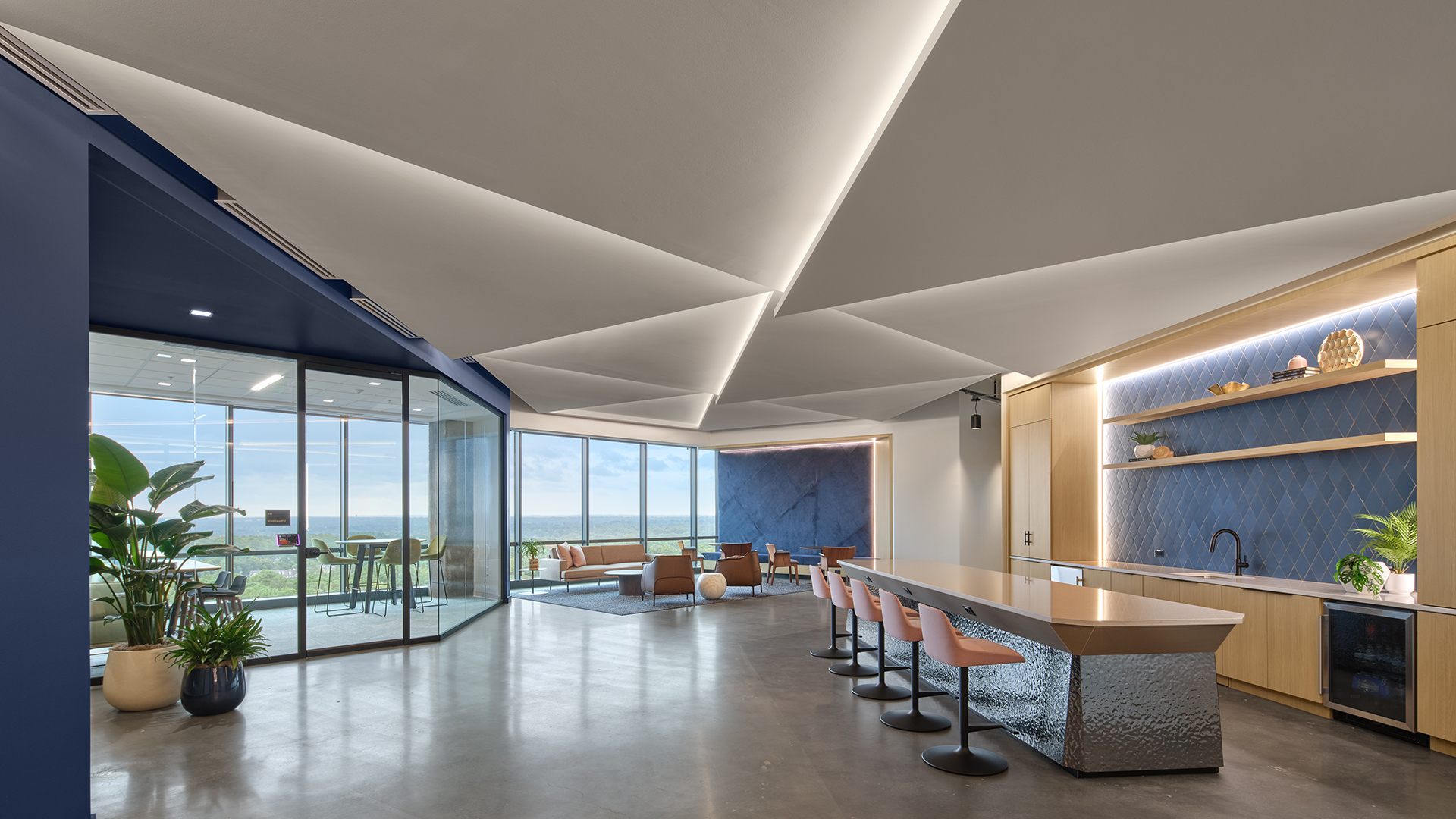
One approach is to guide the eye upward. At Boston Consulting Group, dynamic ceiling forms create a sense of movement and direction that supports intuitive wayfinding while subtly expanding the perceived volume of space. This upward pull helps counterbalance the natural downward focus of screen-based work.
Create Visual Depth and Relief
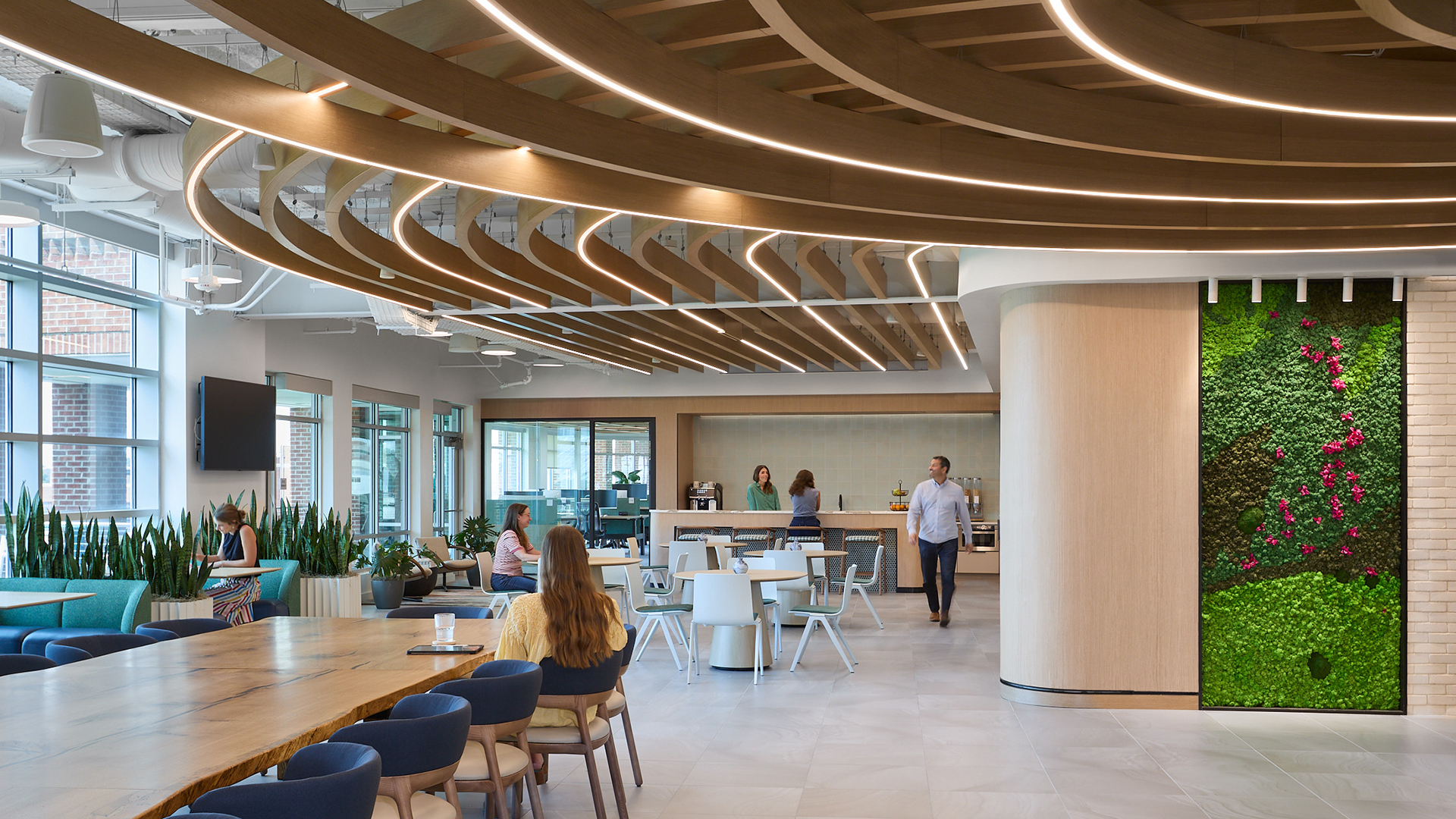
Another strategy is to create visual depth and relief. At Jewelers Mutual, fractal-inspired patterns paired with soft, indirect lighting introduce a level of complexity that mirrors natural systems. This kind of visual structure has been associated with sensory comfort and reduced cognitive strain, helping occupants feel more grounded in high-demand environments.
Simulate Openness and Sky
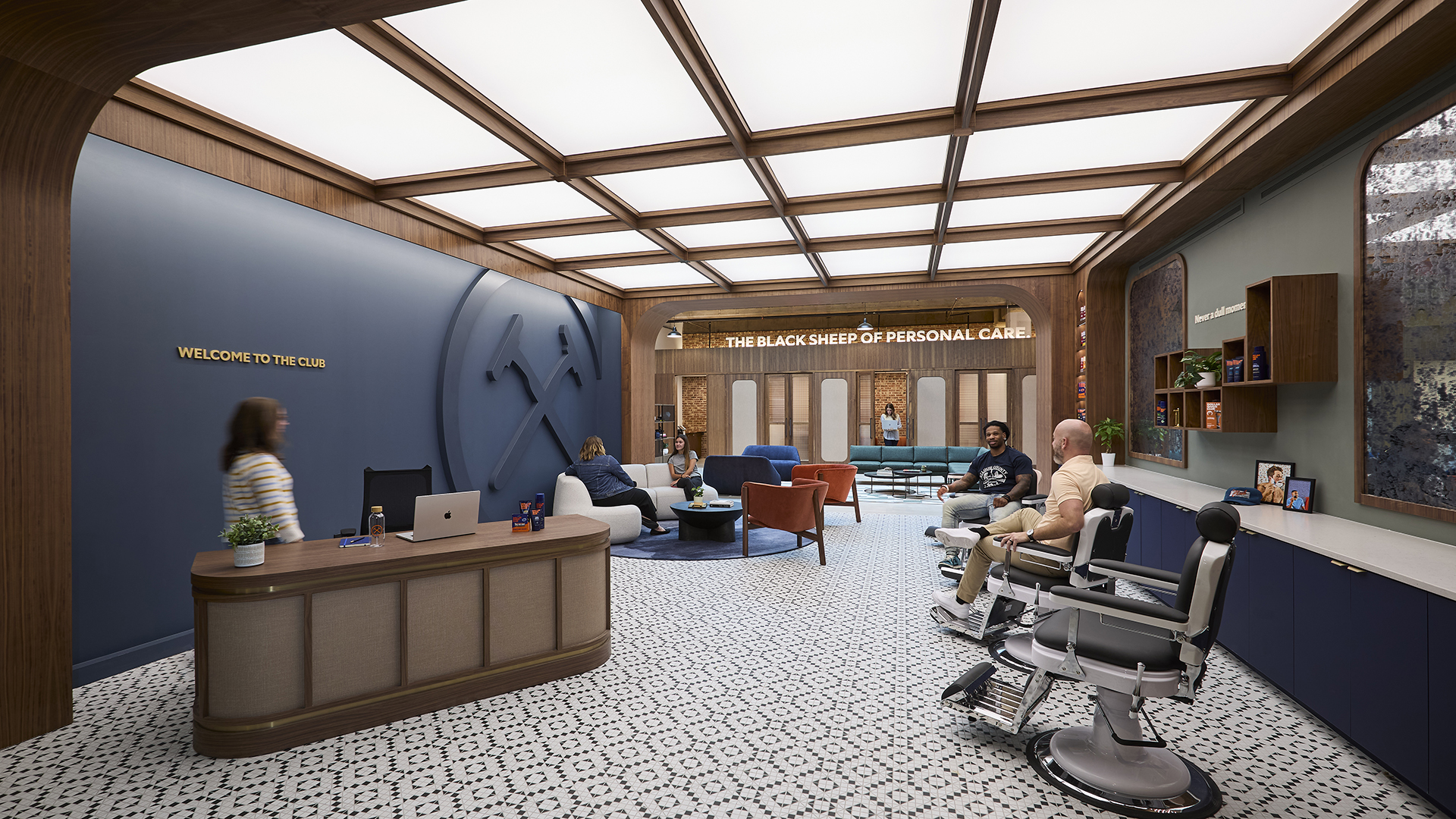
A third approach is to simulate openness and sky. At Dollar Shave Club, luminous ceiling planes create an artificial sense of vertical expansion. These “light skies” soften spatial boundaries and introduce a feeling of openness that can reduce tension and support a more positive emotional state.
CEILINGS AS A COGNITIVE RESET
Ceilings are not passive architectural surfaces. They actively shape how people think, feel, and perform within a space. When we begin to see them this way, a simple shift emerges. What happens above us impacts how we think and work, whether that means supporting conceptual problem-solving, sustaining detail-oriented focus, or simply reducing the sensory load that accumulates over a long day.
This last point matters more than it might initially seem. Not everyone processes space the same way. For neurodiverse individuals (those with ADHD, autism spectrum conditions, or sensory processing differences), the built environment is an active input, not just a backdrop. Thoughtfully designed ceilings, with diffused lighting, sound-absorbing materials, and calibrated visual complexity, can reduce cognitive strain and create a greater sense of safety and calm. And what works for neurodiverse employees tends to work better for everyone. Spaces designed to accommodate a wider range of cognitive needs lower baseline stress, support deeper focus, and make the workplace more equitable by design.
For organizations designing the future of work, this is a clear opportunity. Rethinking overlooked elements of the built environment is not an aesthetic exercise. It is a strategic one. At the end of the day, ceiling design can influence productivity and improve bottom line. Designing for the future of work is a strategic opportunity to move beyond aesthetics and treat the built environment as a lever for organizational performance. Far from being a decorative choice, architectural elements like ceiling design are evidence-based tools that directly influence cognitive function, and designing options for a range of cognitive types helps to situate workplace as an amplifier of productivity and innovation, rather than barrier.